
AI vs Digital Marketer: Who Wins in 2026?
Digital Marketing Strategist in Kannur
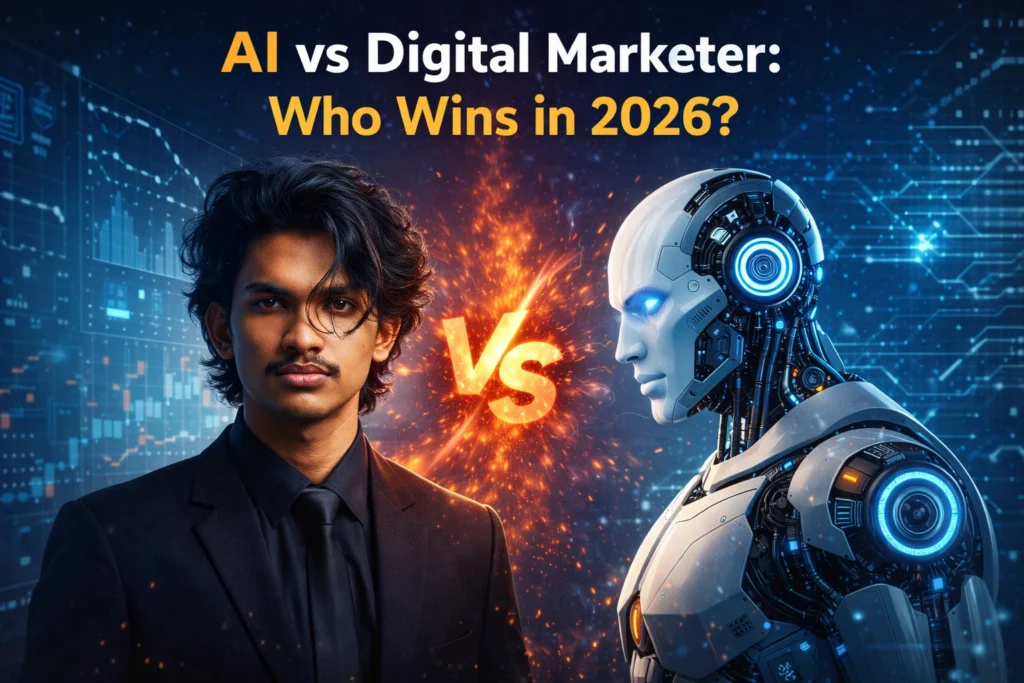
A few years ago, artificial intelligence felt futuristic. Now it’s part of our daily workflow.
Content writing, ad copy generation, logo design, email automation, analytics reporting — tasks that once took hours can now be done in minutes. Tools like ChatGPT and Canva have completely changed how digital marketers operate.
Naturally, this raises a big question: Are digital marketers slowly becoming irrelevant? It’s an uncomfortable thought. But it’s also an important one.
The short answer is no — digital marketers are not being replaced. But average digital marketers? That’s a different story.
AI is incredibly powerful. It can generate captions, suggest headlines, write blogs, analyze data trends, recommend keywords, and even predict campaign performance. It works fast. It doesn’t get tired. It processes massive data instantly. That’s impressive.
But here’s what AI doesn’t truly understand: human emotion. It doesn’t feel cultural shifts. It doesn’t experience market uncertainty. It doesn’t sit in strategy meetings and sense tension. It doesn’t understand why one campaign “feels” right and another doesn’t.
AI can produce content. But it cannot build meaning the way humans do.
Marketing has always been about psychology more than technology. At its core, marketing is about understanding why people behave the way they do — what triggers them, what motivates them, what fears influence their decisions.
AI works with patterns. Humans work with intuition and empathy. That difference matters.
In 2026, the real shift isn’t AI replacing marketers. It’s AI redefining what makes a marketer valuable.
A few years ago, simply knowing how to design a post or write an ad copy made you competitive. Today, AI can do that at scale. So execution alone is no longer a differentiator. Strategy is.
If your entire value as a marketer is based on “creating content,” you are vulnerable. But if your value is based on positioning brands, understanding audience psychology, designing campaign frameworks, and making strategic decisions — you’re not being replaced. You’re becoming more powerful.
AI removes friction. It speeds up production. It reduces repetitive workload. It improves efficiency.
That means marketers now have more time to think. And thinking is where real value is created.
Instead of spending hours drafting captions, you can focus on understanding your audience better. Instead of manually analyzing spreadsheets, you can focus on identifying growth opportunities. Instead of struggling with design tools, you can focus on messaging clarity.
The marketers who win in 2026 are not the ones who ignore AI. They are the ones who master it.
Prompting well requires understanding marketing principles. Refining AI-generated content requires judgment. Evaluating data insights requires experience.
AI is a tool. The marketer is the decision-maker. And decision-making cannot be automated completely.
Another important factor is brand voice. Strong brands have personality. They have tone. They have emotional consistency. AI can imitate tone, but it doesn’t live inside a brand’s long-term vision. That’s why strategic direction still requires humans.
In fact, AI might actually increase demand for skilled marketers. Why? Because as content volume increases, differentiation becomes harder. When everyone can produce content quickly, originality becomes rare. And rare creates value.
The marketers who stand out in 2026 will focus on: Deep audience research, Unique positioning, Storytelling, Personal branding, Cross-platform strategy, Community building. These are areas where human insight matters deeply.
Let’s be honest — some roles will shrink. Basic content production roles may reduce. Simple ad copy generation may become automated. Entry-level repetitive tasks will evolve.
But that doesn’t mean opportunity disappears. It means the bar rises.
Think about it this way: calculators didn’t eliminate mathematicians. They eliminated manual calculation errors and saved time. The real thinkers still thrived.
AI is the calculator of marketing. It removes the mechanical layer and exposes the strategic layer.
If you resist AI, you’ll struggle. If you depend entirely on AI without understanding fundamentals, you’ll also struggle. But if you combine AI speed with human strategy, you create unfair advantage.
The smartest digital marketers in 2026 are not competing against AI. They are collaborating with it. They use it to brainstorm ideas. They use it to test variations. They use it to accelerate workflows.
But they decide what aligns with the brand’s long-term vision.
The real competition isn’t AI vs digital marketer. It’s average marketer vs upgraded marketer.
And upgraded marketers are curious, adaptable, and tech-aware.
The question isn’t “Will AI replace me?” The question is “How can I become irreplaceable?”
To become irreplaceable, focus on: Strategic thinking, Communication clarity, Psychological understanding, Creativity, Brand positioning, Personal branding.
Technology will always evolve. Platforms will change. Algorithms will update. But human behavior will always drive markets. And understanding humans will always be valuable.
In 2026, the winners are not the ones working the hardest. They’re the ones working the smartest.
AI doesn’t eliminate opportunity. It eliminates mediocrity.
If you’re willing to evolve, adapt, and upgrade your skill set, AI becomes your assistant — not your replacement.
The future doesn’t belong to machines. It belongs to humans who know how to use them wisely. 🚀



2 Comments
Greetings I am so delighted I found your blog page, I really found you by error, while I was looking on Bing for something else, Regardless I am here now and would just like to say thanks a lot for a incredible post and a all round interesting blog (I also love the theme/design), I don’t have time to read it all at the minute but I have bookmarked it and also included your RSS feeds, so when I have time I will be back to read a great deal more, Please do keep up the fantastic work.
Thankyouu🤍